
Thailand’s Economy Attracts Stronger Investment Despite Modest Growth
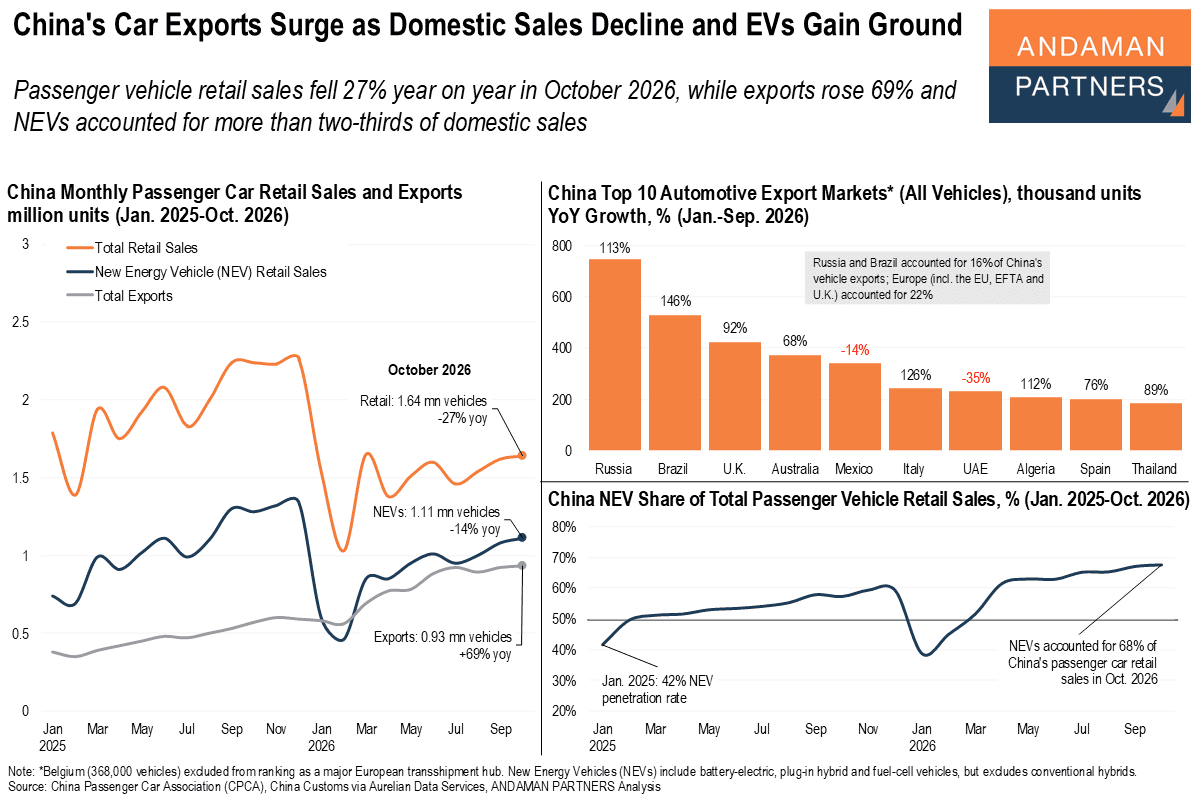
Passenger vehicle retail sales fell 27% year on year in October 2026, while exports rose 69% and NEVs accounted for more than two-thirds of domestic sales.
China’s automotive industry is undergoing a significant transformation in 2026, with new energy vehicles (NEVs) consolidating their position in the domestic market and exports expanding rapidly. While passenger car retail sales have moderated, the broader picture shows changing consumer preferences, growing international reach and intensifying competition across the global automotive industry.
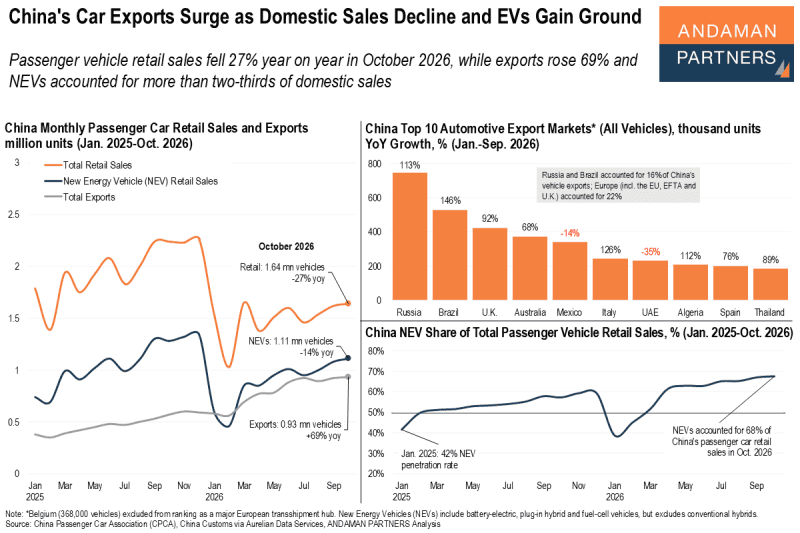
In October 2026, China’s passenger car retail sales reached 1.64 million vehicles, down 27% year on year. NEV sales, including fully electric and plug-in hybrid vehicles, totalled 1.11 million, down 14%. Nevertheless, NEVs accounted for 68% of all domestic passenger car retail sales, up from about 42% in January 2025. This illustrates a fundamental shift in China’s automotive market: even as overall sales fluctuate, Chinese consumers are increasingly choosing electrified vehicles over conventional combustion-engine models.
Internationally, China’s automotive industry continues to expand its reach. Passenger car exports reached 930,000 vehicles in October, up 69% year on year. For all vehicle categories, Russia and Brazil were the two largest export destinations during January-September 2026, together accounting for approximately 16% of total shipments. The U.K., Australia and Mexico were also major destinations, while exports to Brazil, Italy and Algeria grew particularly strongly. Performance varied across markets, however, with shipments to Mexico and the UAE declining year on year.
These developments highlight the growing importance of international markets for Chinese automakers and the continued transformation of China’s domestic vehicle market. The rise of NEVs is influencing vehicle design, battery technology and supply chains, while expanding Chinese exports are bringing new competition and greater consumer choice to markets worldwide.
For international businesses, China’s automotive industry is increasingly significant not only as a vast domestic market, but also as a major source of vehicles, technology and competitive pressure across the global automotive landscape.
Also by ANDAMAN PARTNERS:
ANDAMAN PARTNERS supports international business ventures and growth. We help launch global initiatives and accelerate successful expansion across borders. If your business, operations or project requires cross-border support, contact connect@andamanpartners.com.

China Keeps Shopping for Services. Are You Selling? By ANDAMAN PARTNERS Co-Founder Rachel Wu
Analysis by ANDAMAN PARTNERS Co-Founder Rachel Wu on Shanghai’s services economy

Shenzhen: Where Entrepreneurs Land and Ideas Take Off by ANDAMAN PARTNERS Co-Founder Rachel Wu
Analysis by ANDAMAN PARTNERS Co-Founder Rachel Wu on what makes the city of Shenzhen different

Chongqing Is Closer Than You Think by ANDAMAN PARTNERS Co-Founder Rachel Wu
ANDAMAN PARTNERS Co-Founder Rachel Wu on a new waterway in southern China that is redrawing the map for western China’s trade
China’s Car Exports Surge as Domestic Sales Decline and EVs Gain Ground
Passenger vehicle retail sales fell 27% year on year in October 2026, while exports rose 69%
China’s Trade Surplus Tops USD 1 Trillion as High-Tech Exports Surge
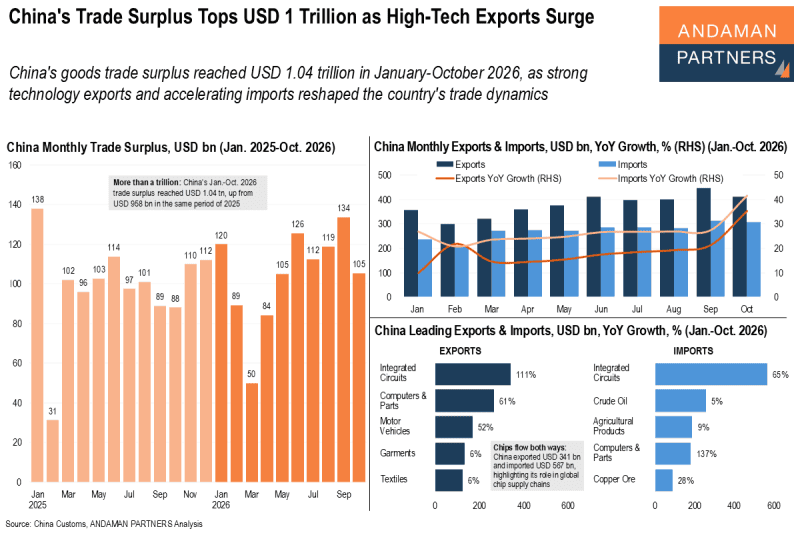
China’s goods trade surplus reached USD 1.04 trillion in the first ten months of 2026
Singapore’s Economy Combines Strong Growth with Rising Foreign Investment
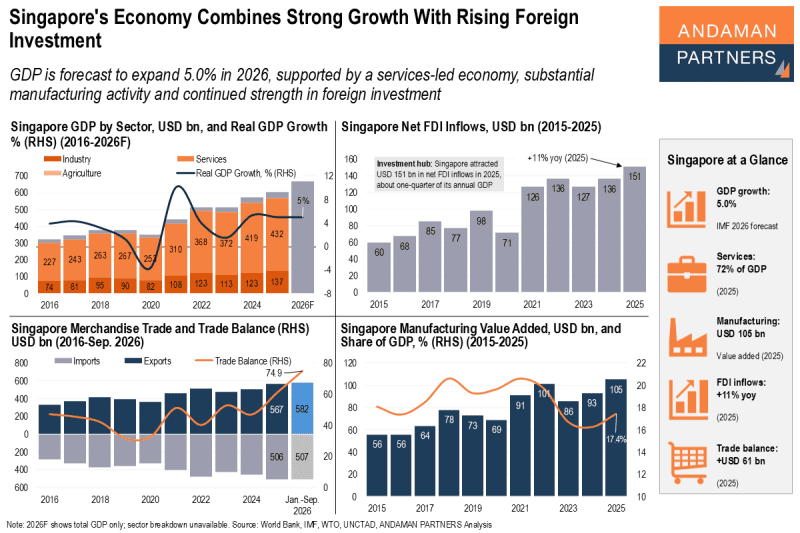
GDP is forecast to expand 5.0% in 2026, supported by a services-led economy