You are currently viewing MENA’s Export Engine Remains Concentrated in Minerals & Fuels, But Diversification Is Emerging

MENA’s Export Engine Remains Concentrated in Minerals & Fuels, But Diversification Is Emerging

MENA’s Trade Growth Is Now Being Driven by Imports

MENA’s Trade Growth Is Now Being Driven by Imports, Not Exports

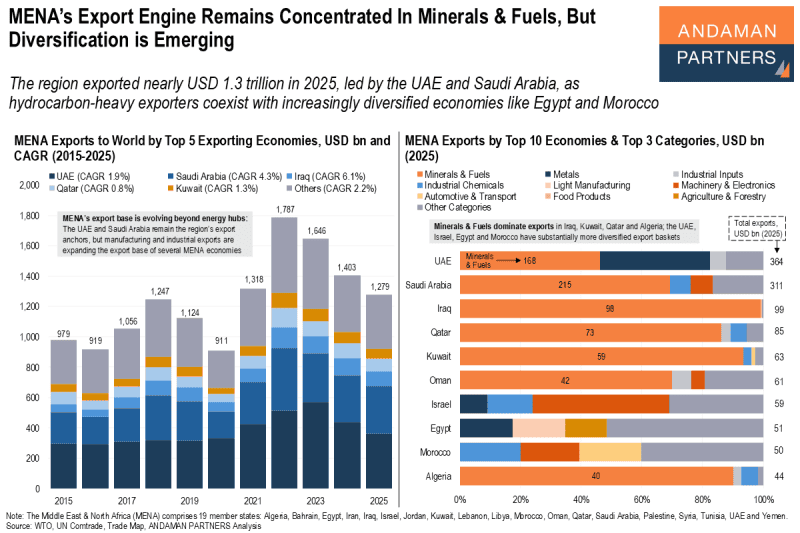
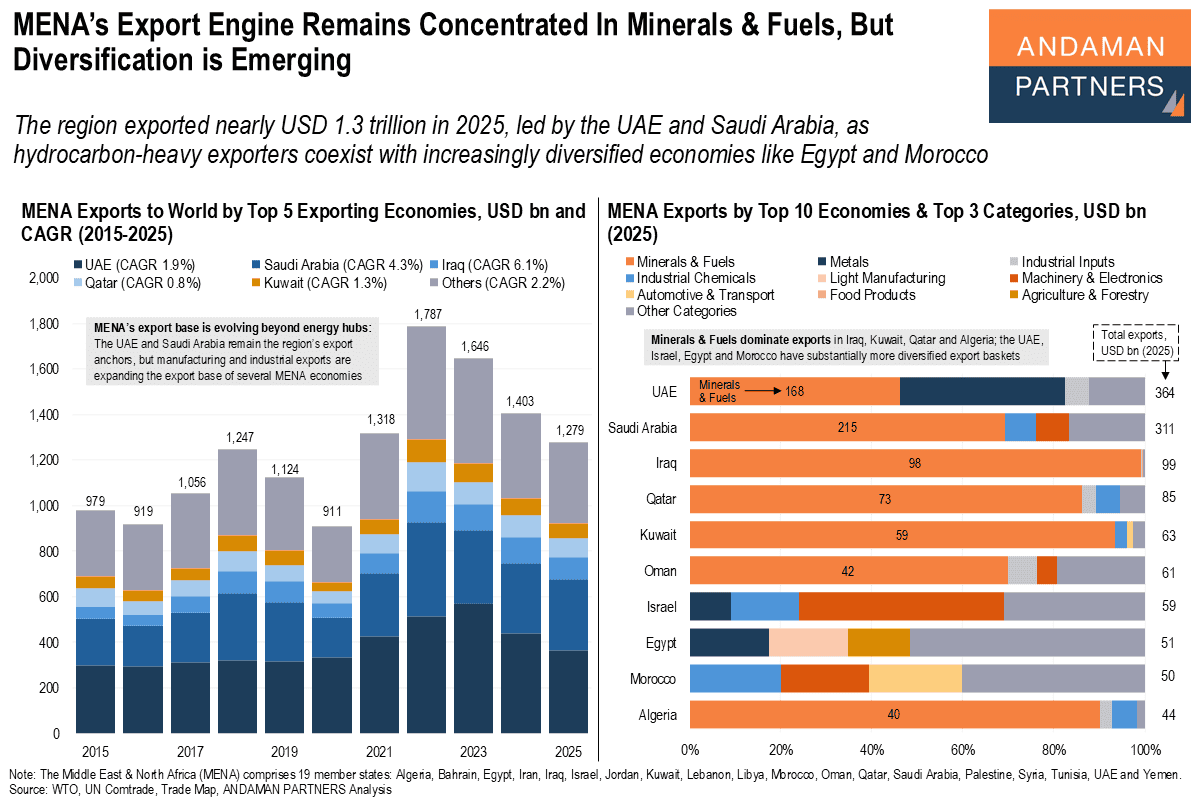
The region exported nearly USD 1.3 trillion in 2025, led by the UAE and Saudi Arabia, as hydrocarbon-heavy exporters coexist with increasingly diversified economies like Egypt and Morocco.
The Middle East & North Africa (MENA), a region consisting of 19 economies, exported nearly USD 1.3 trillion in 2025, with the UAE (USD 364 billion) and Saudi Arabia (USD 311 billion) together accounting for more than half of the total. Over the longer term, Iraq has recorded the fastest export growth among the five largest exporters, at a 6.1% CAGR since 2010, followed by Saudi Arabia at 4.3%.

Beneath those headline numbers, however, are two very different export models. Iraq, Qatar, Kuwait and Algeria remain overwhelmingly hydrocarbon-driven, with Minerals & Fuels dominating their export baskets; Oman and Saudi Arabia are also heavily energy-oriented. At the other end of the spectrum, Egypt and Morocco have much more diversified export baskets, spanning industrial inputs, manufacturing, transport-related goods, food and other categories, while Israel is similarly diversified.

The UAE occupies a distinctive middle ground: Minerals & Fuels remain important, but Metals, Industrial Inputs and its role as a major trading hub give it a substantially broader export base than most Gulf energy exporters. This broader regional diversification is also visible in Egypt, where non-oil exports reached USD 48.6 billion in 2025, up 17% year on year.

For businesses, this increasingly means approaching MENA as several export economies rather than a single hydrocarbon market. Energy and commodity value chains will remain central, but the expansion of manufacturing, logistics, industrial goods and non-oil trade is creating a wider set of opportunities around the region. The longer-term opportunity lies in that combination: MENA retaining its global strength in energy while developing deeper and more diverse trade ecosystems around it.

Also by ANDAMAN PARTNERS:

ANDAMAN PARTNERS supports international business ventures and growth. We help launch global initiatives and accelerate successful expansion across borders. If your business, operations or project requires cross-border support, contact connect@andamanpartners.com.

Media
News & Events
Knowledge