ANDAMAN PARTNERS Wishes You a Happy and Prosperous Year of the Horse!
Compliments of the Chinese Lunar New Year to all our clients, customers, suppliers and partners.
NOTE: This is a brief summary of the full Country Profile, which can be viewed or downloaded at the link below.
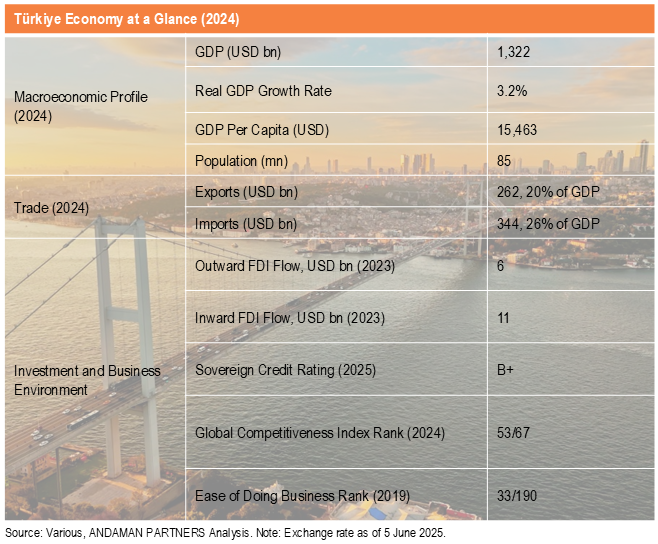
Türkiye has a GDP of USD 1.3 trillion (2024) with real GDP growth of 3.2%, driven by strong domestic demand and public spending, but with the challenges of inflation and currency volatility.
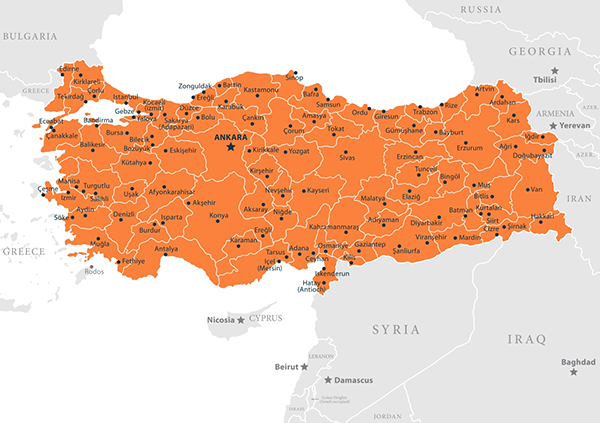
Türkiye has a total land area of 783,356 square kilometres.
Government is a presidential representative democracy and a constitutional republic.
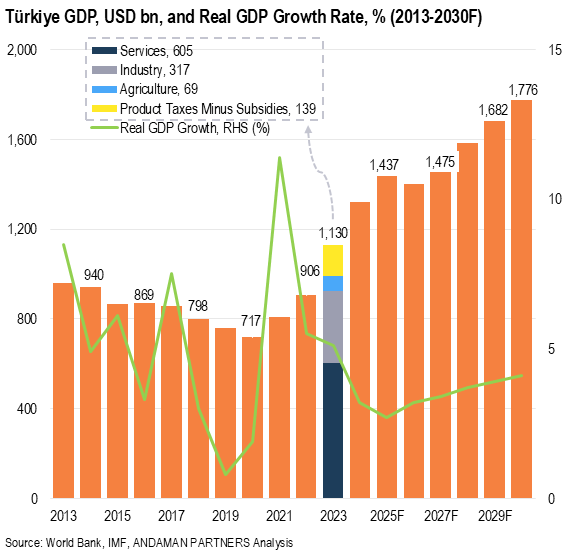
Türkiye’s GDP is forecast to reach USD 2 trillion in 2030, with gradual growth in GDP per capita to USD 20,176.
Inflation peaked in 2022 (72.3%), and has remained above 50% in 2022-2023. Türkiye’s currency has been volatile compared to its peers, with sharp declines from 2017 to 2024.
Central government debt peaked in 2021 during the COVID-19 pandemic and has declined since, reaching 32% of GDP in 2023. Household consumption has trended sharply upwards from 2020.
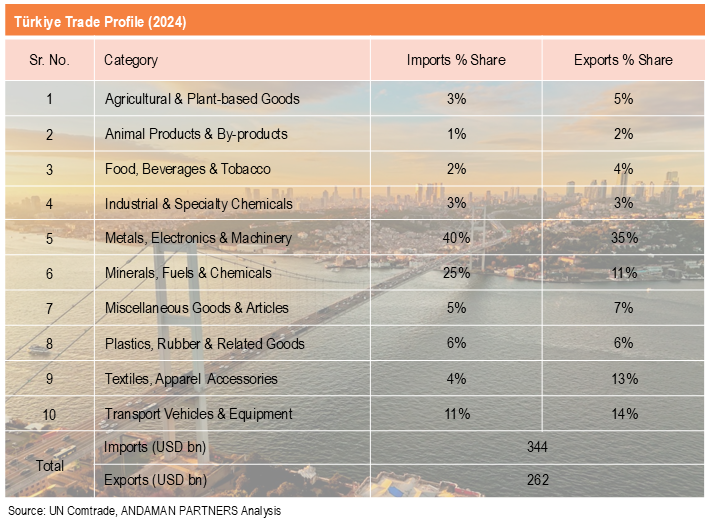
Total trade amounted to USD 606 billion in 2024. Metals, Electronics & Machinery was the largest sector, followed by Minerals, Fuels & Chemicals.
Leading export partners (2024): Germany (USD 20.4 billion), U.S. (USD 16.3 billion), U.K. (USD 15.3 billion).
Leading import partners (2024): China (USD 44.9 billion), Russia (USD 44.0 billion), Germany (USD 27.1 billion).
To download the full Country Profile, please see the option below.
ANDAMAN PARTNERS supports international business ventures and growth. We help launch global initiatives and accelerate successful expansion across borders. If your business, operations or project requires cross-border support, contact connect@andamanpartners.com.

Compliments of the Chinese Lunar New Year to all our clients, customers, suppliers and partners.

ANDAMAN PARTNERS Co-Founders Kobus van der Wath and Rachel Wu will attend Investing in African Mining Indaba 2026 in Cape Town, South Africa.
ANDAMAN PARTNERS is pleased to support and sponsor this popular Pre-Indaba event in Cape Town.

The new framework could unlock growth in non-commodity exports, especially food, autos and industrial intermediates.

India’s momentum is anchored in broad-based household demand, supported by urbanisation, middle-class expansion and consumer import intensity.

Most firms now use AI, but enterprise-wide scaling remains rare, meaning productivity gains are concentrated in a small group of larger firms.